
Options Strategy: The Wheel
If you've read the two articles before this one: Covered Call: collecting rent while holding stock CashSecured Put: collecting rent while ho…
If you've read the two articles before this one:
- Covered Call: collecting rent while holding stock
- Cash-Secured Put: collecting rent while holding cash
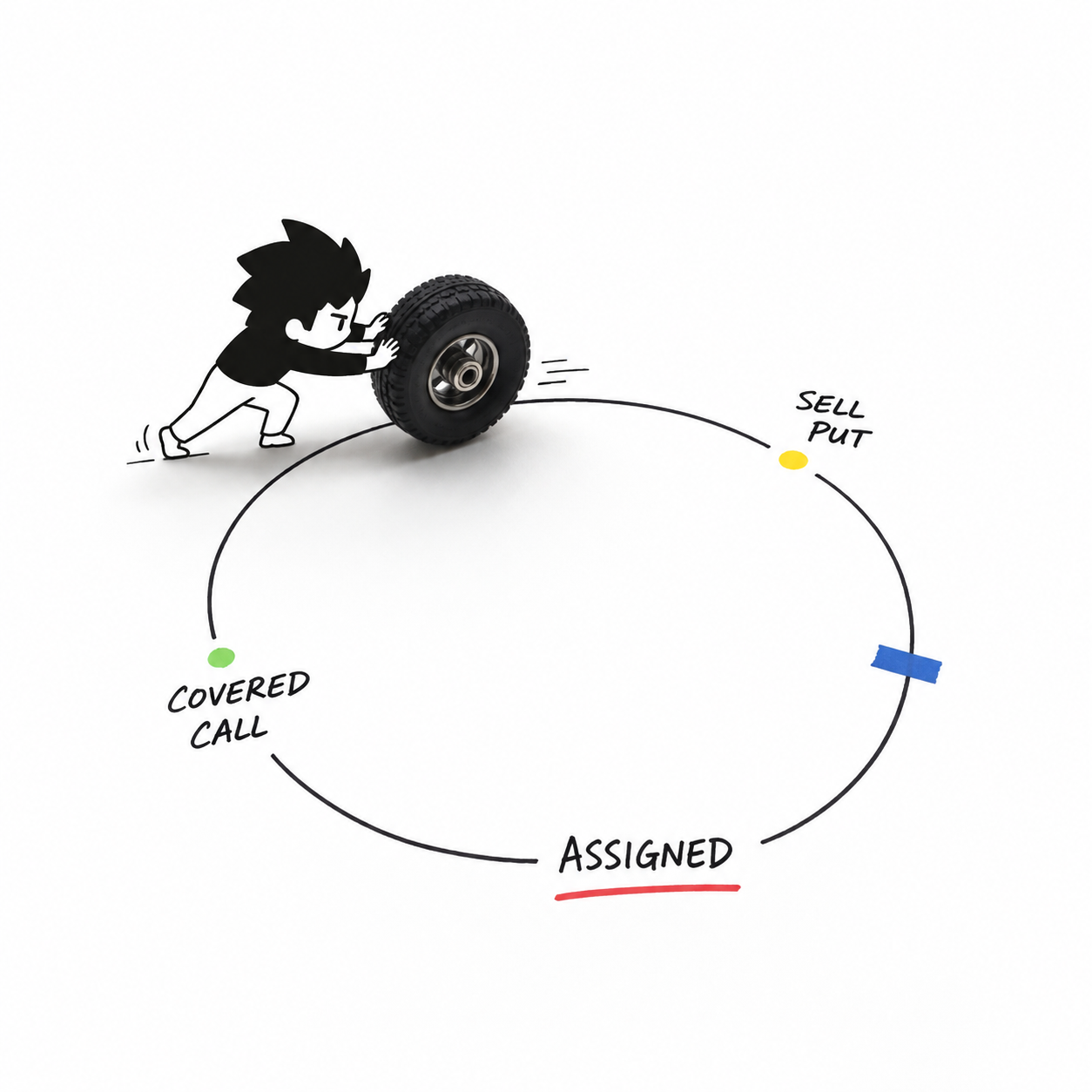
Then The Wheel is stringing them into a closed loop.
The Wheel isn't a new standalone strategy — it's a process: a system that keeps you in a "rent-collecting" state regardless of market conditions.
The Core Flowchart
Phase 1: Cash-Secured Put
Hold cash and sell put options.
- If the stock does not fall: keep the premium and repeat CSP.
- If the stock falls below the strike: accept assignment and buy the stock.
↓
Phase 2: Hold Stock + Covered Call
Hold stock and sell call options.
- If the stock is flat or rises slightly: keep the premium and repeat CC.
- If the stock rises past the strike: the stock is called away and you return to cash.
↓
Back to Phase 1
With cash back in hand, sell CSP again and start the next cycle.
Three Phases Broken Down
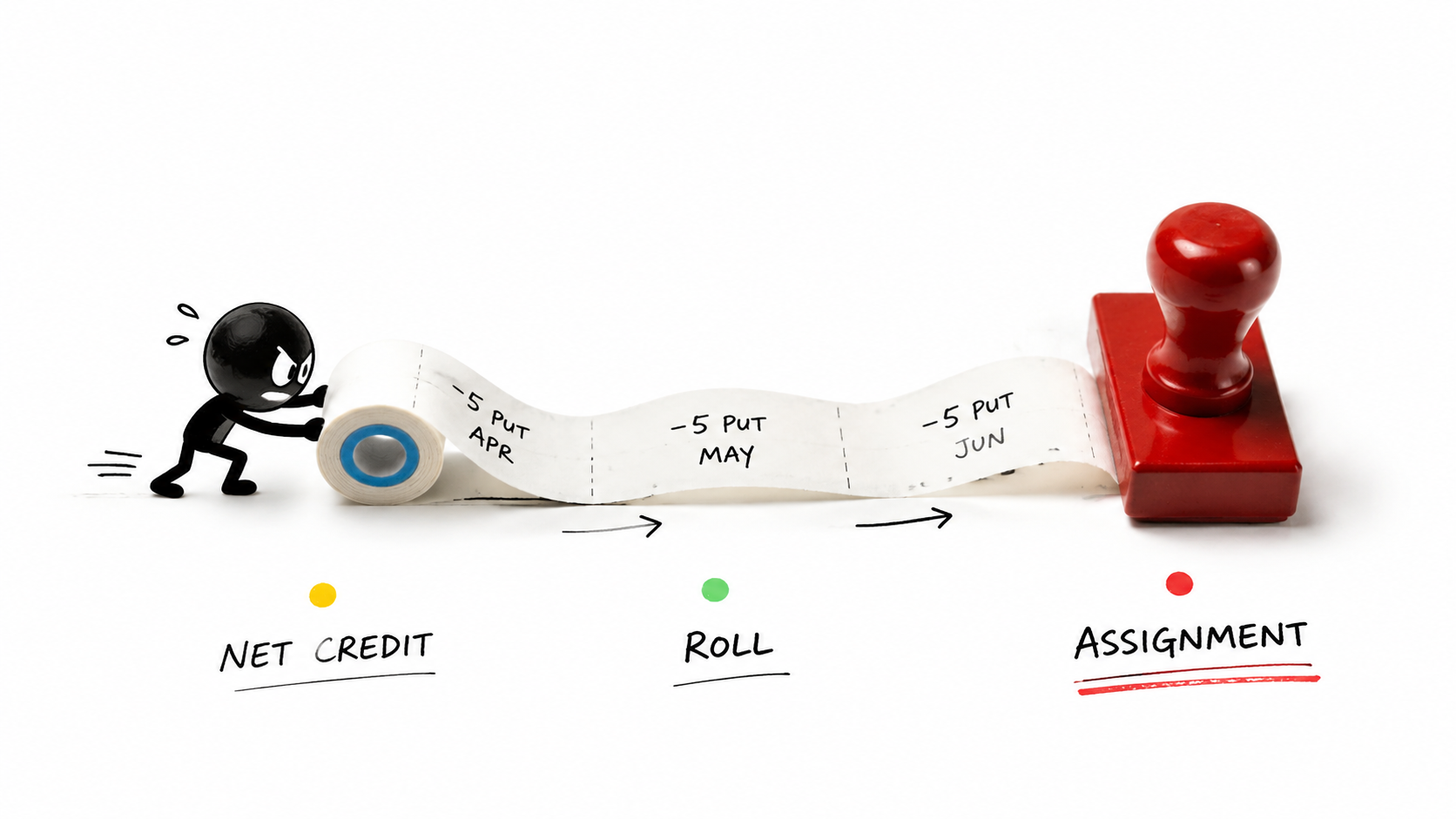
Phase 1: CSP Phase — "Waiting for the Deal"
- State: You hold cash.
- Action: Sell an OTM put.
- Goal: Either keep the premium for free, or buy the stock at a discount.
- Option selection: Strike 5%-10% below current price, expiration 3-6 weeks.
Two possible outcomes:
| Outcome | Stock Price Behavior | Result |
|---|---|---|
| Good outcome | Stock > strike at expiration | Keep the premium, cash intact → repeat CSP |
| Assignment outcome | Stock < strike at expiration | Buy shares at strike price → enter Phase 2 |
Phase 2: CC Phase — "Holding Stock, Collecting Rent"
- State: You hold stock (cost = strike − premium received).
- Action: Sell an OTM call.
- Goal: Reduce cost basis, or sell the stock at your target price.
- Option selection: Strike 5%-10% above current price, expiration 3-6 weeks.
Two possible outcomes:
| Outcome | Stock Price Behavior | Result |
|---|---|---|
| Good outcome | Stock < strike at expiration | Keep premium, continue holding stock → repeat CC |
| Exit outcome | Stock > strike at expiration | Stock called away, cash received → back to Phase 1 |
A Complete Wheel Strategy Example
Say you're interested in XYZ stock, currently trading at $100.
Round 1 (CSP Phase):
- Sell the $95 put, expiring in one month, collect $2 premium.
- Outcome A: Stock at $102 one month later → put expires worthless. Net gain $200, cash still $9,500. Repeat CSP.
- Outcome B: Stock at $90 one month later → assigned at $95, buying 100 shares. Effective cost = $95 − $2 = $93. Enter Phase 2.
Round 2 (CC Phase, assuming assignment):
- Hold 100 shares, cost basis $93. Current stock price $92.
- Sell the $100 call, expiring in one month, collect $1.50 premium.
- Outcome A: Stock at $98 one month later → call expires worthless. Net gain $150, continue holding 100 shares with a further-reduced cost basis. Repeat CC.
- Outcome B: Stock at $105 one month later → stock called away at $100. Cash received = 100 × $100 = $10,000. Total profit = ($100 − $93) × 100 + $150 = $850. Back to Phase 1.
Round 3 (back to CSP):
- You now hold $10,000 in cash.
- Sell the put again… the cycle continues.
Key Parameters for the Wheel
| Parameter | Recommended Setting (Beginners) | Reason |
|---|---|---|
| Underlying | Stocks/ETFs you're willing to hold long-term | No panic if assigned |
| Strike (CSP) | 5%-10% OTM | Balances premium vs. assignment probability |
| Strike (CC) | 5%-10% OTM | Balances premium vs. exit probability |
| Expiration | 3-6 weeks | Moderate management frequency, decent time value |
| Position size | ≤ 20% of total capital per underlying | Diversify risk |
Where the Wheel's Profits Come From
The Wheel earns money from three sources:
- Time value (Theta): Whether CSP or CC, you're always selling options — time is on your side.
- Volatility premium: The options you sell typically have higher implied volatility than realized volatility (statistically true over time).
- Natural stock appreciation: When the stock is called away, you capture the gain from assignment price to strike.
Risks of the Wheel
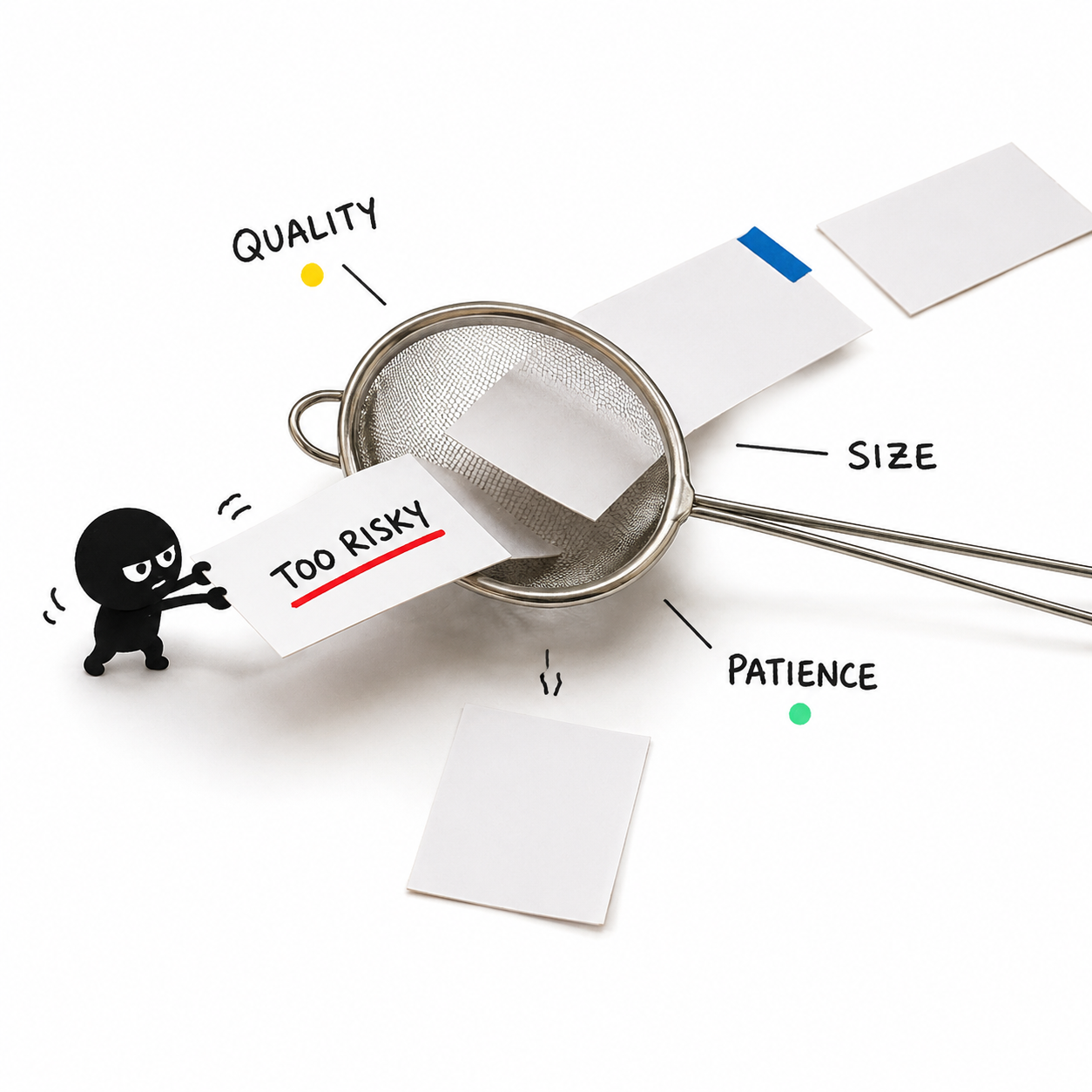
No strategy is perfect. The Wheel's main risks:
| Risk | Description | How to Handle |
|---|---|---|
| Stock crashes | Assigned during CSP phase, stock continues falling | Choose quality underlyings, avoid concentrated positions |
| Stock rockets | CC phase — stock called away early, missing the big run | Sell more OTM calls, or accept "earning less is still earning" |
| Sustained decline | After assignment, stock stays below cost for a long time, CC premium is thin | Keep selling calls to reduce cost, or cut the loss |
| Liquidity risk | Some option contracts have poor liquidity, wide bid-ask spreads | Stick to major ETFs or high-volume stocks |
Who Is the Wheel NOT For?
- People chasing big gains: The Wheel is a "slow money" strategy; 10%-30% annualized is a realistic expectation.
- Active technical traders (frequent direction switching): The Wheel requires some patience; it's not designed for daily pivots.
- Accounts that are too small: The Wheel requires sufficient cash (for CSP) or stock (for CC); $10,000+ is a reasonable minimum.
Beginner Steps to Start the Wheel
- Pick 1-3 ETFs or stocks you know well (recommend starting with broad-market ETFs like QQQ or SPY).
- Start in the CSP phase: sell 5%-10% OTM puts, expiration 3-6 weeks.
- Record the premium and effective cost for each cycle.
- Switch to CC immediately upon assignment.
- Run it for 6+ months and track total returns and annualized yield.
One-Line Summary
The Wheel = cycling between CSP and CC, keeping you in a rent-collecting state whether you hold cash or stock.
It won't make you rich overnight, but it will teach you the most fundamental truth in options trading:
You don't make money by predicting direction — you make money by "providing liquidity to the market" and "selling time."
Once you can run the Wheel consistently for 6+ months, you'll have transformed from an "options beginner" into a "systematic options trader."