
Options Strategy: Covered Calls — A Beginner's Guide
If you could take one idea from this article, I'd want it to be: Many beginners' first options trade is "buy a call on some stock" — which i…

If you could take one idea from this article, I'd want it to be:
For your first options trade, don't try to predict direction — sell something you're willing to hold.
Many beginners' first options trade is "buy a call on some stock" — which is essentially guessing up or down. The odds are 50%, and then you also need direction, magnitude, and timing to all align. The win rate is terrible.
I recommend every beginner set their first strategy as a Covered Call.
What Is a Covered Call?
One-line definition: Hold 100 shares of stock, and simultaneously sell one call option.
Concrete example:
- Suppose a stock is trading at $100.
- You buy 100 shares for $10,000.
- You sell one call with a $105 strike, expiring in one month, and receive $2/share in premium ($200 total).
Result:
- You immediately receive $200 cash.
- Your cost basis drops from $100 to $98 ($100 − $2).
- Your obligation: if the stock is above $105 at expiration, you must sell those 100 shares at $105.
What Happens in Three Scenarios?
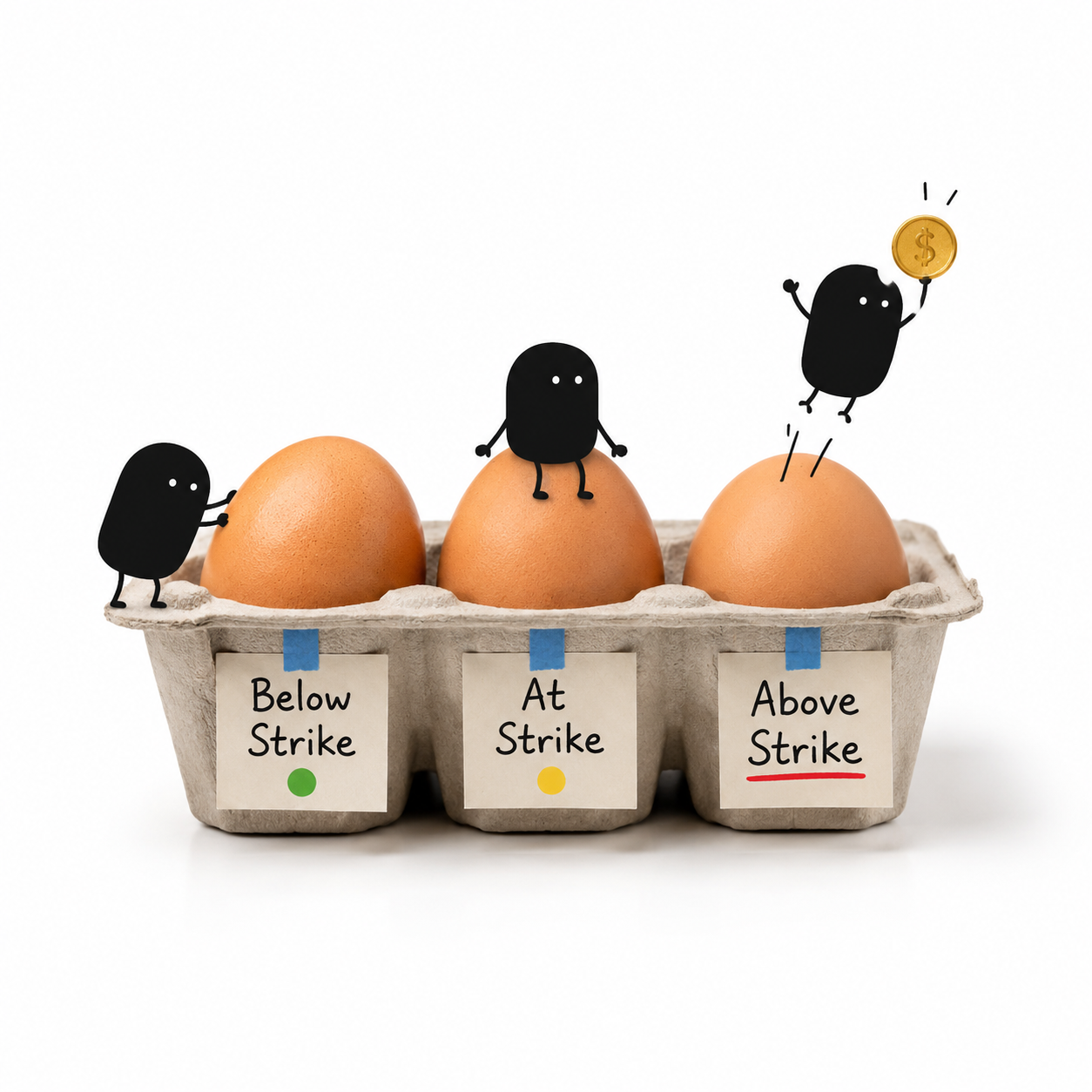
| Stock at Expiration | What Happens | Final P&L (per share) | Notes |
|---|---|---|---|
| $90 (down) | Stock down $10, option expires worthless | Received $2 premium, stock lost $10 → net loss $8 | Lost $2 less than holding stock outright |
| $100 (flat) | Stock flat, option expires worthless | Net gain $2 (entirely from premium) | Holding stock outright earns nothing; you earned |
| $108 (strong rally) | Stock up $8, but must sell at $105 (missed $3) | Stock gain $5 ($105−$100) + $2 premium = net gain $7 | You gave up the excess upside beyond the strike |
The Core Logic of Covered Calls
- Earn time value: As long as the stock doesn't exceed the strike, you're a pure "landlord" collecting rent. Theta (time decay) is your friend.
- Provides a downside buffer: The premium acts like a small cushion on your stock position. When the stock falls 10%, you only lose 8%.
- Give up the big rally fantasy: If you truly believe a stock could double in the short term, don't do a covered call. Covered calls are for stocks you expect to appreciate moderately or trade sideways.
Why Is This Strategy Suitable for Beginners?
| Common Beginner Pain Point | How Covered Calls Help |
|---|---|
| Don't know if it will go up or down | Doesn't rely on directional judgment; you earn in sideways markets too |
| Buy and it immediately drops, psychologically crushing | Premium provides a buffer, reduces anxiety |
| Always want to get rich quick | Trains your patience for "slow money" |
| Don't understand the Greeks | Just need to understand: selling options = collecting rent |
The key point: This strategy cannot blow up. You're holding stock, so the worst case is the stock declining (the same as if you held outright) — there's no margin call risk.
Two Choices in Practice
Choice 1: Sell an OTM call (recommended for beginners)
- Strike above the current price (e.g., stock at $100, sell the $105 or $110 call).
- Lower premium, but retains some upside participation.
- Suitable for: mildly bullish or neutral.
Choice 2: Sell an ATM call (more aggressive)
- Strike at or just below the current price.
- Higher premium, but you've almost entirely given up upside.
- Suitable for: strongly believe the stock won't rally much; want to maximize rental income.
Beginner advice: Start by selling calls 5%-10% OTM. You get some upside room and premium income.
A Complete Beginner Walkthrough (Paper or Small Real-Money Account)
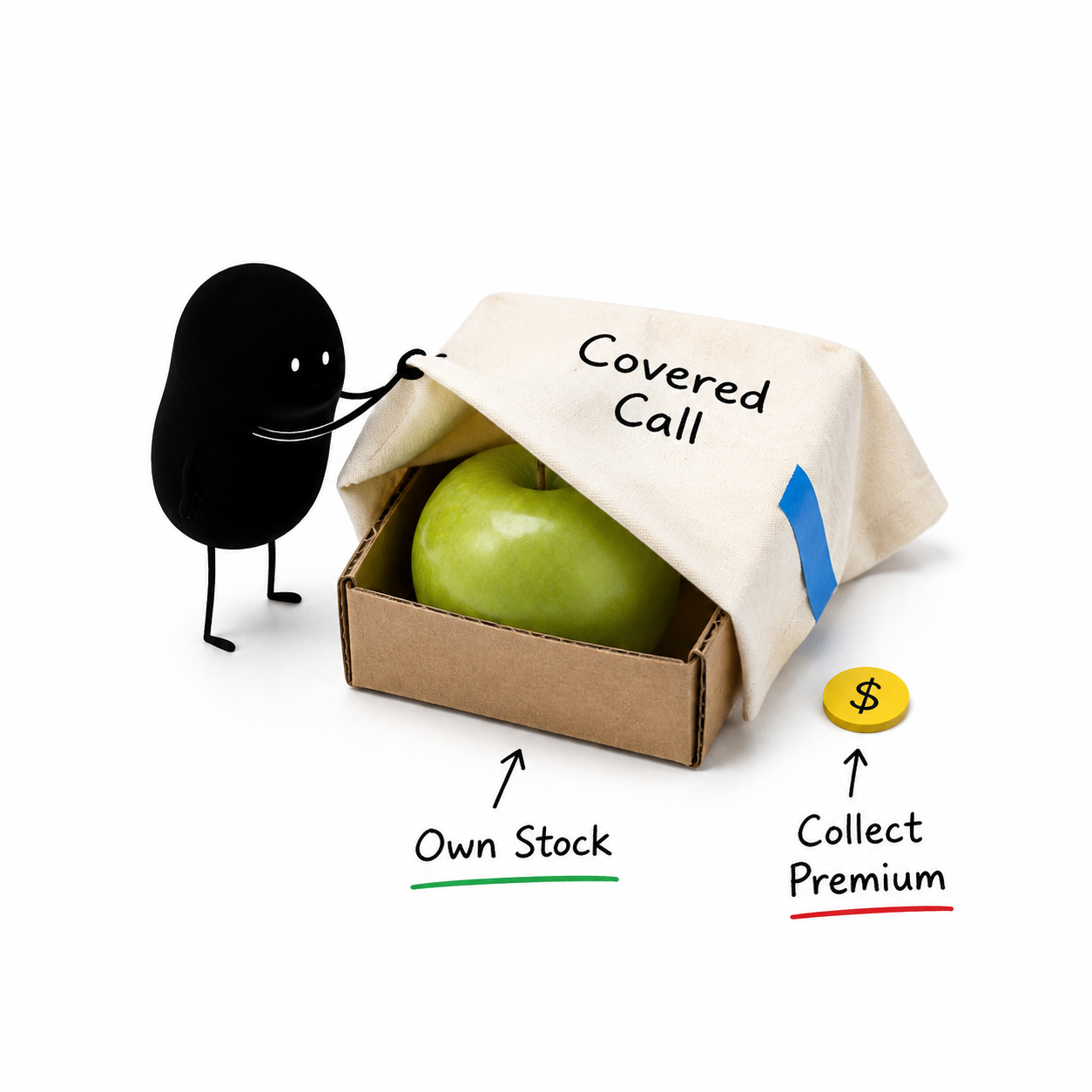
- Pick a stock you're willing to hold for 1-3 months (ideally low-volatility and one you know well).
- Buy 100 shares (or a whole-lot multiple).
- Sell 1 OTM call (strike 5%-10% above current price, expiration 3-6 weeks out).
- Record the premium you received.
- Hold to expiration or close early (if stock approaches the strike, you can buy back the option to keep the stock).
Common Q&A
Q: If the stock rallies past the strike and gets called away, what do I do? A: That's part of the strategy. You sold the stock at an agreed price and also earned premium. Even though you missed some gains, you're still profitable. If you're still bullish, wait for a pullback and buy back, or roll to the next month.
Q: What if the stock drops sharply? A: Your loss is smaller than holding stock outright. The premium is your cushion. You can also continue selling further-dated calls to keep reducing your cost basis.
Q: Do I need to watch it constantly? A: No. Covered calls are a low-maintenance strategy — check the price once a week is enough.
Summary: Covered Calls Aren't the Most Profitable Strategy, But They're the Most "Anti-Fragile" for Beginners
They won't make you rich overnight, but they'll help you build two things:
- Basic trust in options — they really can generate rental income; options aren't a scam.
- Respect for time — watching premium slowly arrive every day is far more grounding than betting on direction.
Once you've earned your first "time value" paycheck via covered calls, you'll have the genuine confidence to understand options more deeply.
Then we'll talk about spreads, iron condors, ratio spreads…