
Options Basics: The Four Key Greeks
Many beginners' first reaction to Delta, Gamma, Theta, and Vega is: "I'm here to trade stocks, not take a math exam." Then they skip the Gre…
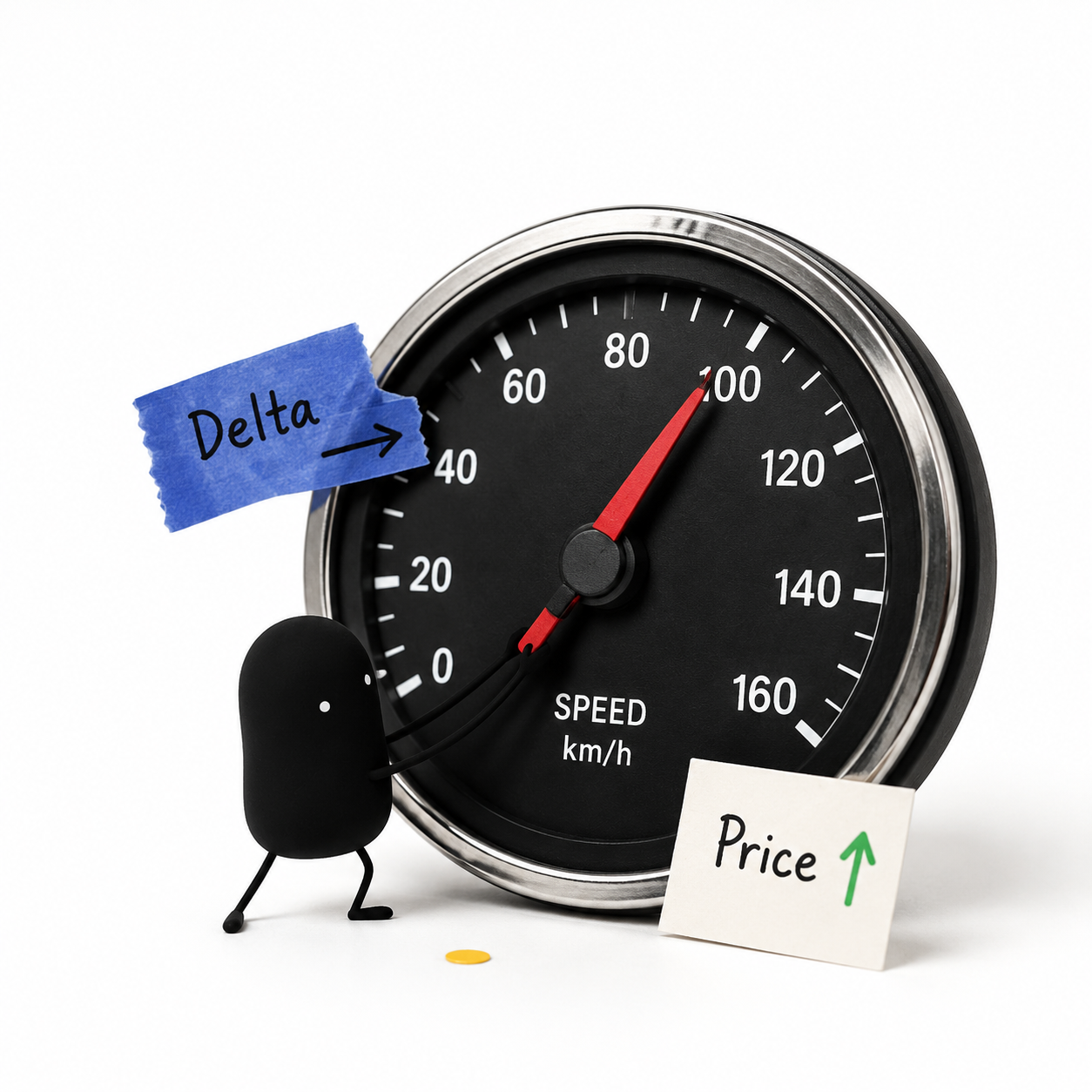
Many beginners' first reaction to Delta, Gamma, Theta, and Vega is: "I'm here to trade stocks, not take a math exam." Then they skip the Greeks entirely and treat options as pure directional bets.
That's the biggest mistake options beginners make — and the root cause of most losses.
The Greeks aren't math. They're translators — they convert the logic behind option price changes into a language you can understand. Learn them, and you'll finally know why an option's price goes up or down instead of staring blankly and saying: "I got the direction right. Why am I still losing?"
Let's use four everyday analogies to explain them all at once.
Delta: The Speedometer
Delta measures: roughly how much the option price changes when the stock moves $1.
- Delta ranges from 0 to 1 (for calls). A Delta of 0.5 means: if the stock goes up $1, the option goes up $0.50.
- The closer Delta is to 1, the more the option tracks the stock (deep ITM).
- The closer Delta is to 0, the more "unresponsive" the option is (deep OTM).
Everyday analogy: Delta is your speedometer. You need to get from A to B (you got the direction right), and the faster the car, the better your chances. A deep OTM option is like a car idling at a stop (Delta ≈ 0.05) — the stock surges 10 yards, and your option barely moves half a step. Getting the direction right still won't earn you much.
Beginner tip: When buying options, check the Delta. Options with Delta below 0.3 are "lottery-type" contracts — you need direction, magnitude, and timing to all be right before you profit.
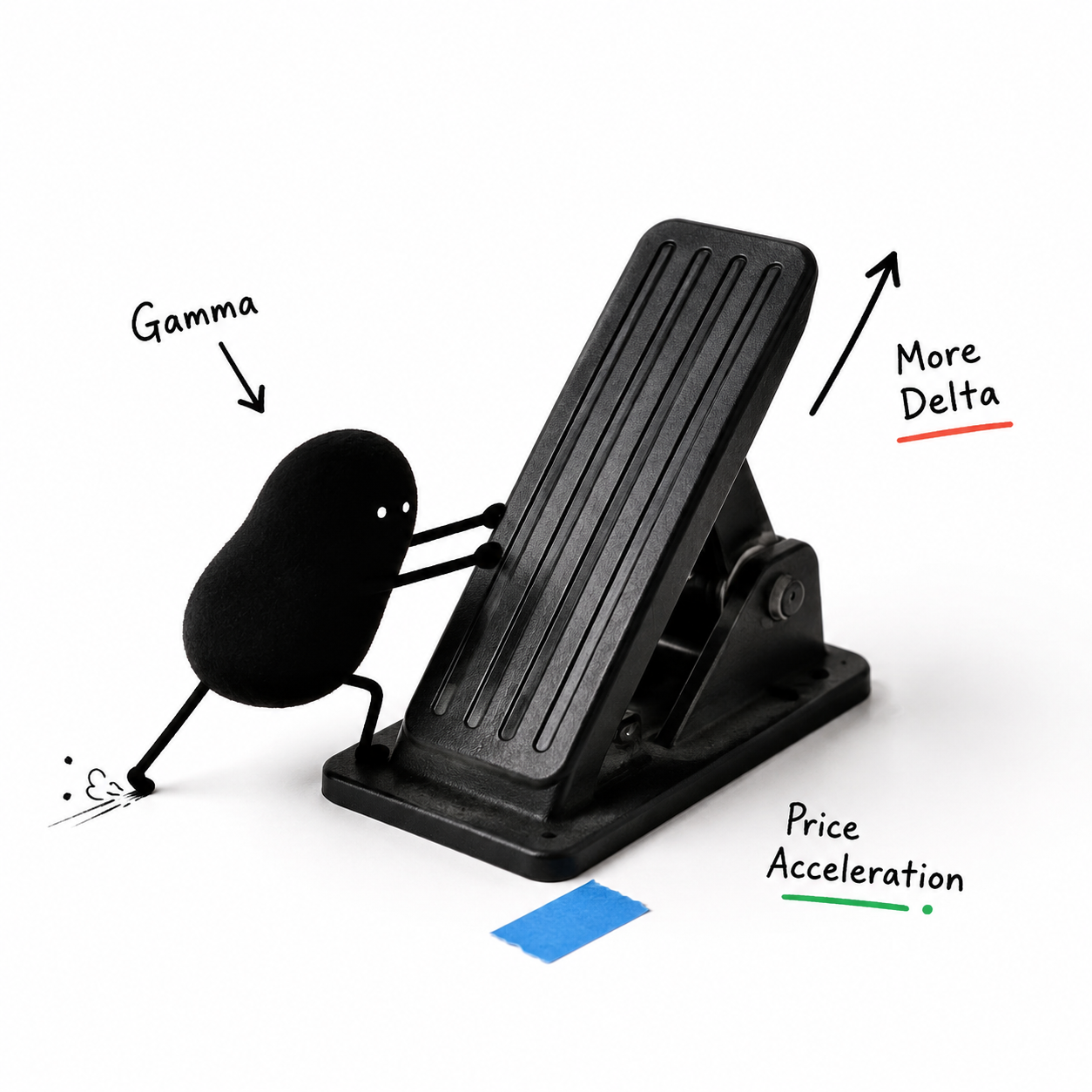
Gamma: The Gas Pedal
Gamma measures: how much Delta itself changes when the stock price moves.
- Gamma is the rate of change of Delta. As stock price rises, Delta increases (the car accelerates).
- Gamma is highest near at-the-money (ATM) options. When the stock starts moving from ATM, the option becomes "increasingly sensitive."
Everyday analogy: Gamma is the gas pedal. Right off the line (near ATM), one press of the pedal gives you the biggest surge (Gamma is highest). Once the car is already at 60 mph (deep ITM), the same press barely adds speed (Gamma approaches 0).
Common beginner trap: Many beginners like buying ATM options because they seem "cheap." But ATM options have the highest Gamma, meaning price swings violently amplify your P&L. Going up feels great; going down hurts just as fast.
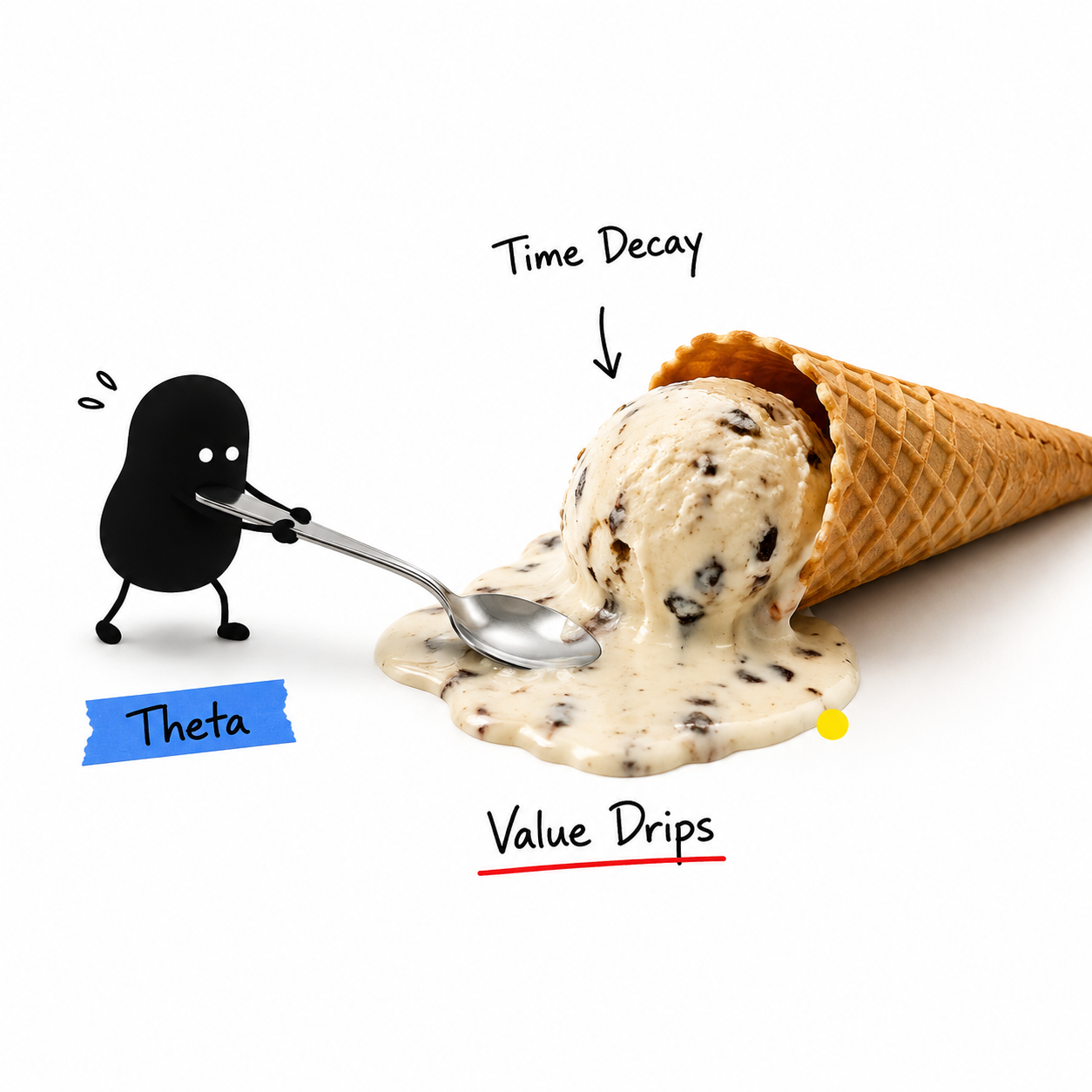
Theta: Melting Ice Cream
Theta measures: how much option price decays every day (time value).
- Theta is typically negative (from the buyer's perspective). A Theta of −0.05 means: you lose $5 of time value every day.
- The closer to expiration, the larger the absolute value of Theta (time decay accelerates).
Everyday analogy: Theta is ice cream in summer. No matter how careful you are, it's melting. The closer to expiration, the faster the melt — in the final week, it's like a cone that's almost gone; one small jolt and it's all over.
Beginner soul-searching question: You buy an option expiring in one month. Assuming the stock doesn't move at all — how much is your option worth after 30 days? Answer: close to zero. That's the power of Theta — time is your enemy.
Vega: The Butterfly Effect of Volatility
Vega measures: how much the option price changes when implied volatility (IV) changes by 1%.
- Volatility can be thought of as "how scared or excited the market is." During major news events, earnings, or crises, volatility spikes.
- Vega is largest in ATM and longer-dated options.
Everyday analogy: Vega is a weather forecast. If you sell umbrellas (option seller) and the forecast calls for a typhoon next week (volatility spike), umbrella prices immediately double, even though it hasn't rained yet. If you bought an umbrella (option buyer), a typhoon is great — but if the typhoon never comes (volatility reverts), umbrella prices collapse. Even if it doesn't rain, your umbrella has lost value.
The fatal beginner trap: Many people buy options to bet on earnings. After the report, the direction was right but the option still lost money. Why? Because pre-earnings IV was extremely high (high Vega), and after the report, "uncertainty was removed," causing volatility to crash and option prices to collapse — this is called IV crush.
Four Greeks Together Tell One Story
Suppose you buy a call option:
- Stock rises (Delta earns you money).
- Stock accelerates higher (Gamma earns you even more).
- Time passes each day (Theta quietly takes a cut).
- Market suddenly panics (Vega makes the option more expensive — or cheaper, depending on direction).
An option's price is the result of these four forces interacting.
Three Lines to Remember
- Don't just look at direction. Even a correct directional call can lose money because of Theta and Vega.
- The Greeks aren't math — they're a language. Learn to read them and you can interpret an option's "EKG."
- Lesson one for beginners: understand your risk exposure before thinking about profits.
Next article: we'll tackle a more fundamental question — should you be a buyer or a seller? Which is better for beginners?