
Options Basics: Three Common Beginner Traps
In futures markets, "margin calls" are a welldiscussed risk. In options markets, there's a quieter and far more common outcome — going to ze…
In futures markets, "margin calls" are a well-discussed risk. In options markets, there's a quieter and far more common outcome — going to zero.
A margin call at least means you had big swings. Going to zero is often a slow boil: you didn't get the direction wrong, you didn't use massive leverage, but your option contract silently expires worthless.
The three traps below are where options beginners suffer the most casualties. Each is easy to fall into, and each is hard to climb out of alone.
Trap 1: Buying Deep Out-of-the-Money Options — The Epitome of "Cheap for a Reason"
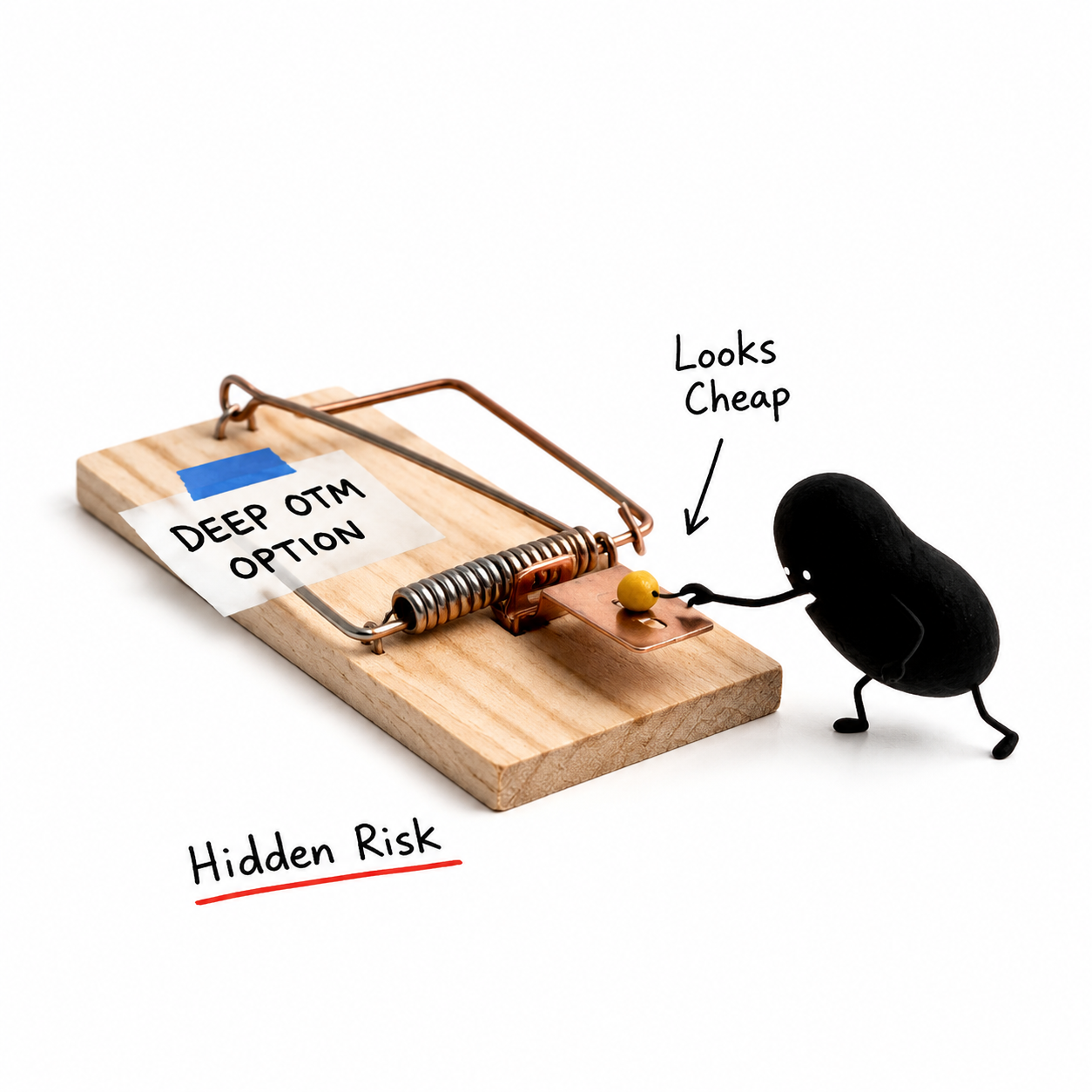
What happens: A stock is at $100. A beginner sees a $120 call for only $0.50 and thinks: "So cheap! If it goes up 20% I'll be rich." They buy a large position.
Why it's a trap:
- Delta is extremely low (near 0): If the stock goes from $100 to $105, your $120 call barely moves — the market thinks it "still can't reach $120."
- Theta decay is extremely high: Deep OTM options are almost entirely time value, which melts away rapidly every day.
- You need direction + magnitude + timing to all align: Even if you get the direction right, if it doesn't move fast enough, far enough, or before expiration, you still go to zero.
A real simulation:
- Buy a $120 call for $0.50, expiring in one month.
- At expiration, stock has risen to $119 (one dollar short) — option is worth zero (since $119 < $120, no exercise).
- You were right about "going up," but not "going above $120." You lose everything.
Beginner rule: Don't buy options with Delta < 0.2 as investments — treat them as lottery tickets (under 1% of total capital).
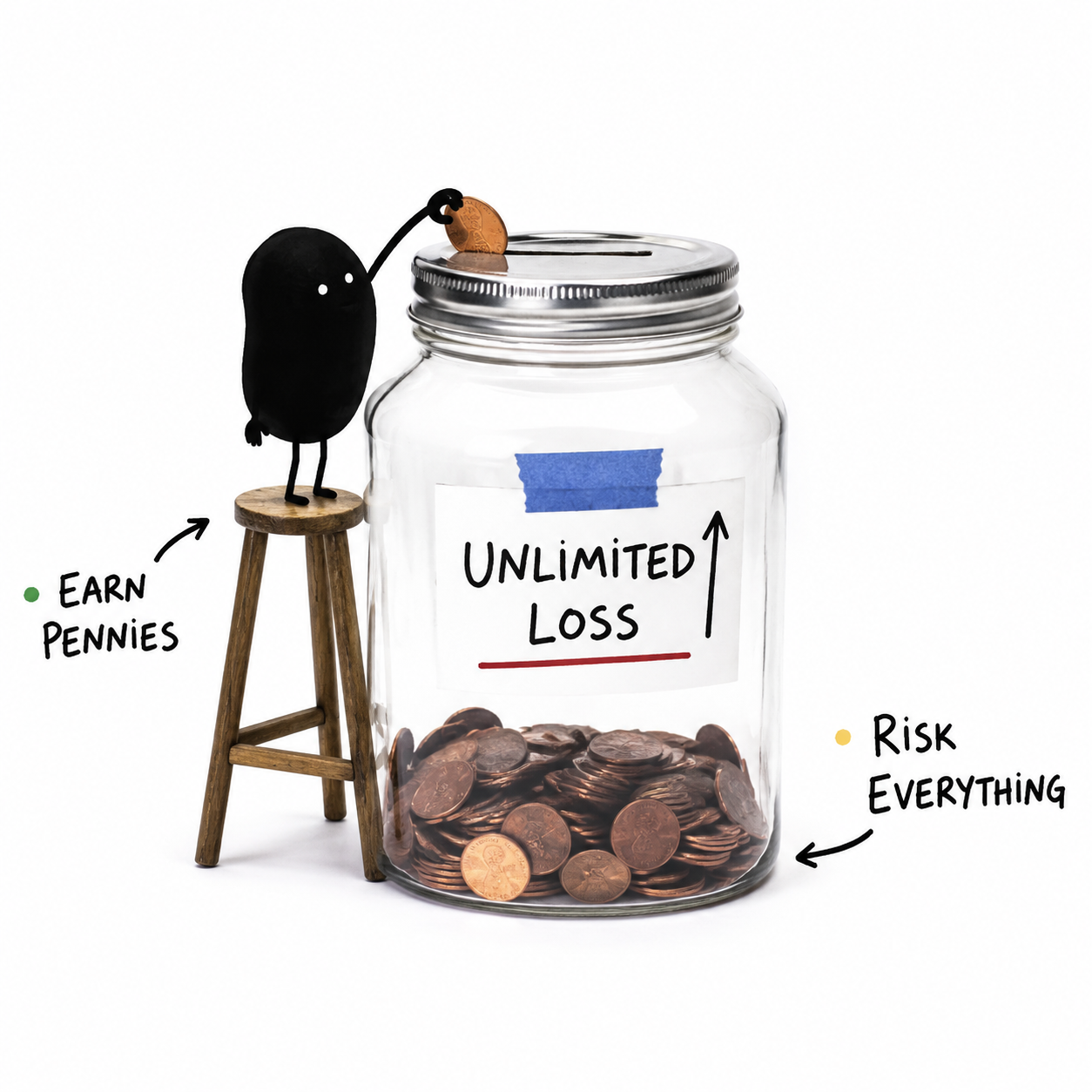
Trap 2: Naked Short Options (Naked Calls/Puts) — "Earn Pennies, Risk Everything"
What happens: A beginner sees "sell one call option, instantly receive $500 premium" and thinks it's easy money. What they miss: they don't own the underlying stock or futures.
Why it's a trap:
- Theoretically unlimited losses: If the stock rockets, you must sell it at the contracted low price (without owning it), which means buying it at market price to fulfill the obligation.
- Margin will blow up: When the trade goes against you, the exchange will continuously demand more margin until you're force-liquidated.
A classic example (simplified):
- Stock at $100. Beginner sells a $110 call, collecting $2 premium.
- Company surprises with major news; stock jumps to $200.
- Beginner must sell stock at $110 (losing $90/share), but their income was only $2.
- Risk/reward ratio: earn $2 vs. lose $90 (or more).
Absolute rule for beginners: Until you fully understand the dynamic margin calculation for options, never sell naked. If you want to be a seller, start with covered calls or cash-secured puts (with enough cash to accept assignment).
Trap 3: Ignoring Volatility — "I Got the Direction Right — Why Am I Losing Money?"

What happens: Before earnings, a beginner buys calls, betting the report will beat expectations. It does — stock rises 5%. They excitedly open their account and find — the option is down 20%.
Why it's a trap:
- Implied volatility (IV) is extremely high before earnings: Heavy option buying for hedging inflates option prices.
- After earnings, "uncertainty resolved," IV collapses: This is called an IV crush.
- Vega damage > Delta gain: The appreciation from a 5% stock move isn't enough to offset the depreciation from a 20-point IV drop.
A simplified data example:
| Before Earnings | After Earnings | |
|---|---|---|
| Stock Price | $100 | $105 (+5%) |
| Implied Volatility | 60% (very high) | 30% (reverted) |
| Option Price | $5.00 | $3.80 (-24%) |
Result: stock went up, option went down.
How beginners should handle this:
- Don't buy options right before big events (earnings, FDA decisions, elections). If you must, use a spread strategy (like a bull call spread) to reduce Vega exposure.
- Think in reverse: if you're the seller at major events (e.g., selling straddles/strangles), the collapsing volatility works in your favor.
Summary: The "Survival Mantra" for All Three Traps
| Trap | Core Problem | One-Line Defense |
|---|---|---|
| Deep OTM | Win rate is terrible, time decay is fast | Don't buy Delta < 0.2 options as investments |
| Naked short | Limited upside, unlimited downside | No hedge = no selling |
| Ignoring volatility | Direction was right, but IV killed you | Don't buy before big events — or use spreads |
Final Thought
There's an old saying in options markets: "Buyers lose because they picked the wrong contract; sellers blow up because they didn't hedge."
For beginners, the most important goal in your first year isn't to make money — it's to survive. Avoid these three traps and you're already ahead of 90% of traders at your level.
Next article: we'll shift from defense to offense, with the first practical strategy for beginners.