
Options Advanced: Four Ways to Roll
Many traders first hear about "rolling" as damage control before assignment. But rolling is far more than damage control. In an advanced tra…
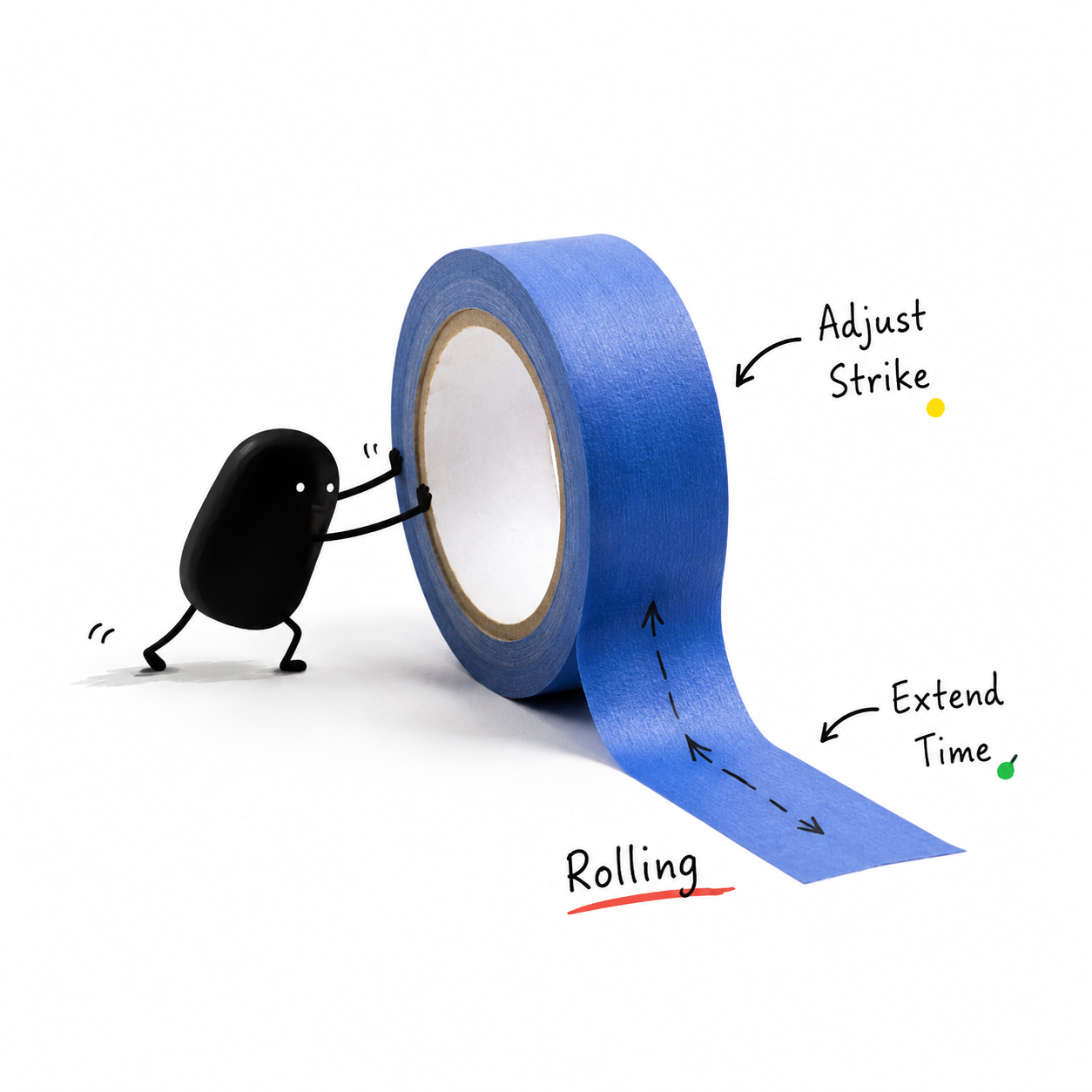
Many traders first hear about "rolling" as damage control before assignment.
But rolling is far more than damage control.
In an advanced trader's toolkit, Rolling is an active management instrument — you can use it to adjust strike prices, extend trade duration, or even completely restructure your position.
Core insight:
Opening a position is just the beginning. Traders who can't roll are judged by their entry. Traders who can roll always have another move.
Quick Recap: What Is Rolling?
What is Rolling?
Close your current option contract and simultaneously open a new one in the same direction but with a different strike or expiration.
The two basic forms of Rolling:
| Type | Action | Purpose |
|---|---|---|
| Roll Up / Roll Down | Change the strike | Adjust offensive/defensive position |
| Roll Out | Extend the expiration | Buy more time for the trade to work |
| Roll to a New Structure | Change the strategy type | Adapt to changed market conditions |
Important reminder: Rolling usually incurs trading costs (commissions + bid-ask spread). Don't roll just for the sake of rolling.
Advanced Play 1: Roll Up — Release Upside Pressure, Capture More Gains
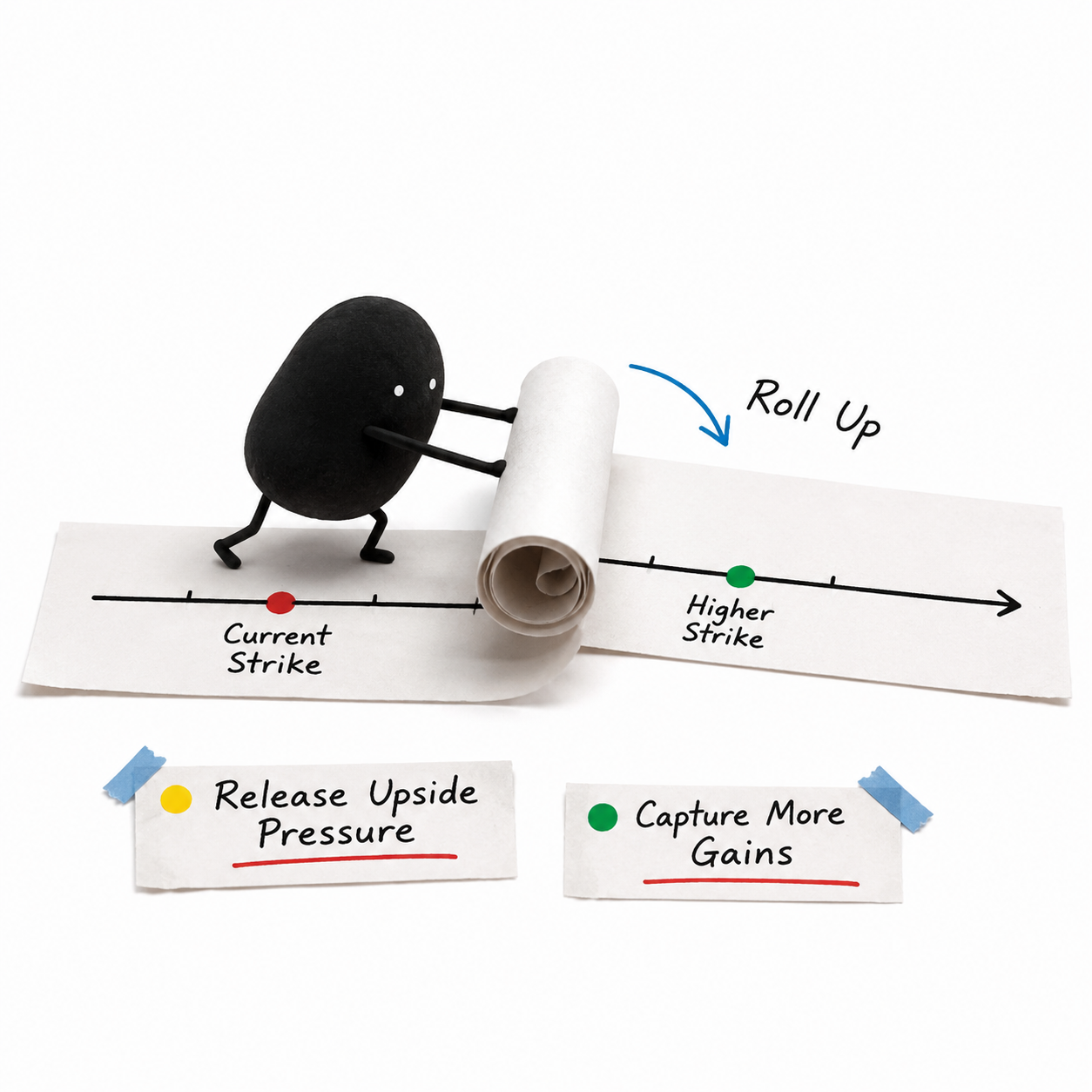
Scenario: You sold a call (covered call or naked call) and the stock has rallied quickly, approaching your strike.
Problem: If you do nothing and assignment happens, you may miss further upside.
Roll Up operation:
- Buy to close your current call (at a loss, since it's now more expensive).
- Sell a call at a higher strike, same expiration.
Numerical example (covered call):
- Initial: hold stock @ $100. Sold $105 call for $2.
- Stock rallies to $104, the $105 call is now worth $1.80.
- Roll Up: buy to close $105 call (pay $1.80), sell $110 call (receive $1.00).
- Net premium change: received $2 − paid $1.80 + received $1 = net credit $1.20 (while the stock continues to rise).
Results comparison:
| Approach | Final outcome if stock reaches $115 |
|---|---|
| No roll | Stock called away at $105; earn $5 capital gain + $2 premium = $7 |
| Roll Up | Stock called away at $110; earn $10 capital gain + $1.20 net premium = $11.20 |
Roll Up risk: If the stock pulls back, your higher strike may never be reached, and you paid extra to close the original call.
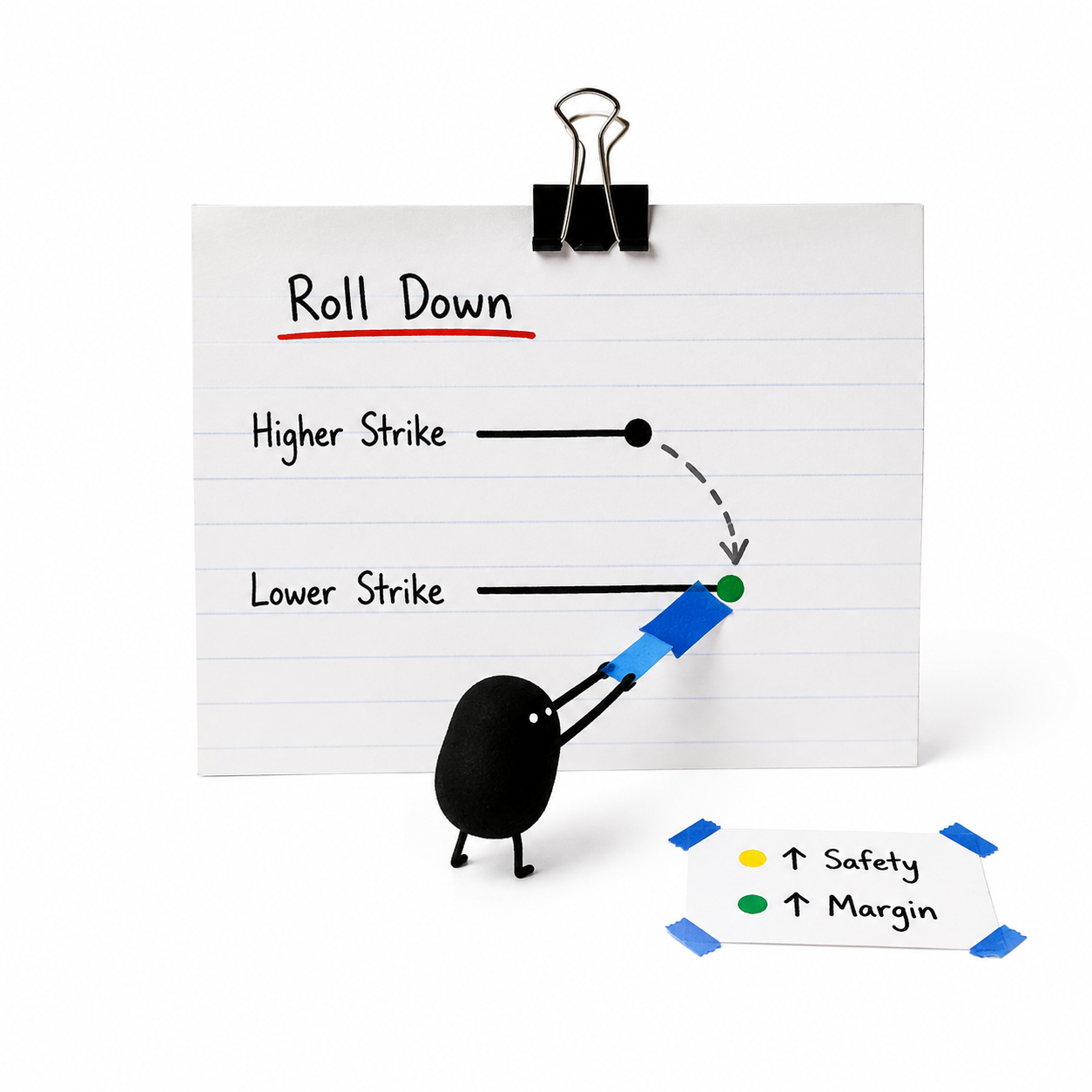
Advanced Play 2: Roll Down — Lower the Assignment Price, Increase Safety Margin
Scenario: You sold a put (cash-secured put) and the stock has fallen, approaching your strike.
Problem: If you do nothing, you may be forced to buy shares near their current price with very little cushion.
Roll Down operation:
- Buy to close your current put (at a loss, since it's now more expensive).
- Sell a put at a lower strike, same or further-dated expiration.
Numerical example (CSP scenario):
- Initial: sold $95 put for $2. Stock at $100.
- Stock drops to $92, the $95 put is now worth $3.50.
- Roll Down: buy to close $95 put (pay $3.50), sell $90 put (receive $2.50).
- Net premium change: received $2 − paid $3.50 + received $2.50 = net credit $1 (strike lowered from $95 to $90).
Results comparison:
| Approach | Final outcome if stock reaches $85 |
|---|---|
| No roll | Assigned at $95; effective cost $93; market price $85 → paper loss of $8 |
| Roll Down | Assigned at $90; effective cost $89 ($90−$1); market price $85 → paper loss of $4 |
Roll Down risk: If the stock rebounds, you gave up the chance to be assigned at $95 (which may have been your target), and you'll collect less premium.
Advanced Play 3: Roll Out — Buy More Time While Waiting for the Trade to Work
Scenario: You sold an option, the position is temporarily against you, but your long-term thesis hasn't changed.
Problem: Expiration is approaching fast and there's no time left to wait for the trade to work.
Roll Out operation:
- Buy to close your current option (at a loss).
- Sell the same strike at a further expiration.
Numerical example (short put scenario):
- Initial: sold $95 put for $2, 30 days to expiration.
- Day 25: stock at $94, the $95 put is worth $1.80 (still a loss).
- Roll Out: buy to close (pay $1.80), sell 60-day $95 put (receive $2.50).
- Net result: $2 − $1.80 + $2.50 = net credit $2.70, expiration extended by 30 days.
Why is it worth doing?
- You not only "moved" the losing position to a later date — you also collected additional premium.
- You gave the trade more time to return to a favorable position.
Core principles for Roll Out:
| Principle | Explanation |
|---|---|
| Only roll positions you still believe in | If your long-term view has changed, don't roll — take the loss |
| Roll far enough | At least roll to the next major time period (e.g., current month → next month) |
| Watch the credit received | If the new premium is very small, the market is signaling the position won't recover |
Advanced Play 4: Roll to a New Structure — Change the Strategy Type Entirely
Scenario: Market conditions have fundamentally shifted and the original strategy no longer fits.
Problem: The original strategy's risk/reward profile no longer matches the current environment.
Structural roll operation: Close part or all of your current strategy and open a different type of strategy.
Common structural roll scenarios:
Scenario A: From naked put to put spread
- Initial: sold $95 put.
- Stock crashes to $80, the $95 put is deep ITM.
- Structural roll: buy a $85 put (creating a put spread) to cap maximum loss.
- Result: you give up some recovery potential but gain a "risk ceiling."
Scenario B: From Iron Condor to Vertical Spread
- Initial: Iron Condor (sell $105 call + buy $110 call + sell $95 put + buy $90 put).
- Stock rallies to $104, approaching the call-side strike.
- Structural roll: close the put-side legs, keep the call-side vertical spread ($105/$110 call spread).
- Result: from "collecting rent on both sides" to "only betting on continued rally," freeing up margin.
Scenario C: From Long Straddle to Risk Reversal
- Initial: long $100 call + long $100 put.
- Stock barely moves but IV has risen.
- Structural roll: close the $100 put, sell a $90 put (turning into a risk reversal: long $100 call + short $90 put).
- Result: reduces overall cost but adds downside risk.
Rolling Decision Tree: When to Roll vs. When to Stop Out
| Situation | Roll? | Recommended Action |
|---|---|---|
| Against you, but long-term thesis intact | ✅ Roll Out | Roll to a further expiration, reduce anxiety |
| Against you, and long-term thesis has changed | ❌ Stop out | Close the position, accept the loss |
| In your favor, want to lock in more profit | ✅ Roll Up / Roll Down | Move strike toward safer territory |
| Market environment has shifted, original strategy invalid | ✅ Structural Roll | Switch to a strategy that fits the new environment |
| More than 2 weeks to expiration | ⏸ Wait | Stay put for now and let Theta work for you |
| Very close to expiration (<3 days) | ✅ Roll or close | Either roll to next month or accept the outcome |
Three-Line Summary
- Roll Up / Roll Down: Adjust your strike — move your "defense line" or "offense line."
- Roll Out: Extend expiration — trade time for the right outcome.
- Structural Roll: Completely change the strategy type to realign the portfolio with the market.
Next article: From "don't blow up" to "mathematically winning" — how to use position sizing, stress testing, and strategy resilience design to make your options trading genuinely controllable.